User-Defined Host Entries Configuration
You can configure user-defined host entries for external resources. This capability enables the configuration of local host records, supplementing hosts resolvable by external DNS server(s).
User-defined host entries can be configured at bootstrap time and/or post-deployment.
The following methods are enabled to configure user host records/entries and local DNS entries.
Configure User-Defined Host Entries During Bootstrap
During the bootstrap phase, update the Ansible playbook override file,
localhost.yaml <hostname.yaml>, with the following data within the
user_dns_host_records section.
To add host records, use the following command syntax:
user_dns_host_records:
  <host-record-name>: <fqdn>[,<fqdn>...],[<IPv4-address>],[<IPv6-address>][,<TTL>]
Where, TTL can be optionally provided and fqdn = fully qualified domain name.
For example:
user_dns_host_records:
  test-server: example.com,192.168.0.1,1234::100,300
  host1: host,example2.com,127.0.0.1
Note
Upon system initialization, you can observe that data has been updated within the system database, and it can be listed using the system CLI.
Configure User-Defined Host Entries via System Inventory API/CLI
After system deployment, update host records using the CLI. Source the script
/etc/platform/openrc to obtain administrative privileges and use the
following procedure:
Procedure
Use the following command syntax to add the parameter.
~(keystone_admin)]$ system service-parameter-add dns host-record <host-record-name>=<fqdn>[,<fqdn>...],[<IPv4-address>],[<IPv6-address>][,<TTL>]
~(keystone_admin)]$ system service-parameter-apply dns
Where fqdn = fully qualified domain name.
For example:
~(keystone_admin)]$ system service-parameter-add dns host-record test-server1=host1,testserver1.com,127.0.0.1

Use the following command syntax to modify the parameter.
~(keystone_admin)]$ system service-parameter-modify dns host-record <host-record-name>:<fqdn>[,<fqdn>...],[<IPv4-address>],[<IPv6-address>][,<TTL>]
~(keystone_admin)]$ system service-parameter-apply dns
Where fqdn = fully qualified domain name.
The following example shows the command syntax to add another DNS name for the existing host entry.
Example:
~(keystone_admin)]$ system service-parameter-modify dns host-record test-server1=host1,host,testserver1.com,127.0.0.1

Follow the steps below to delete the parameter.
Run the command to display the service parameter list for
host-record service-parametertype.~(keystone_admin)]$ system service-parameter-list | grep host-record
Copy the UUID of the parameter that needs to be deleted.
Run the command to delete the entry.
~(keystone_admin)]$ system service-parameter-delete <uuid>
For example:
~(keystone_admin)]$ system service-parameter-delete a24e147f-2d13-4d7b-a8e7-47a1d77b95b5
Configure User-Defined Local DNS Scope Entries
You can configure user-defined domain entries within the local DNS scope to
prevent DNS queries for those domains from being forwarded to external DNS
server(s) (i.e. nameservers in system dns-show/dns-modify).
This capability enhances the User-Defined Host Entries Configuration``by
ensuring that resolution of these entries occurs strictly within the local DNS
scope (for example, resolving ``registry.central in subcloud environments).
This setup is especially beneficial for systems using a single IP stack
(either IPv4 or IPv6). If the system uses only IPv4 and receives DNS queries
for both IPv4 and IPv6 for registry.central, dnsmasq can respond locally
with the IPv4 record and disregard the IPv6 query.
Without this configuration, IPv6 queries would be unnecessarily forwarded to external DNS server(s), causing delays in resolution and impacting application performance.
User-defined DNS local scope entries can be configured post-deployment.
Configure User-Defined Local DNS Scope Entries via System Inventory API/CLI
After system deployment, update DNS local scope entries using the CLI. Source
the script /etc/platform/openrc to obtain administrative privileges and use
the following procedure:
Procedure
Use the following command syntax to add the parameter.
~(keystone_admin)]$ system service-parameter-add dns local <local-scope-name>=<domain>
~(keystone_admin)]$ system service-parameter-apply dns
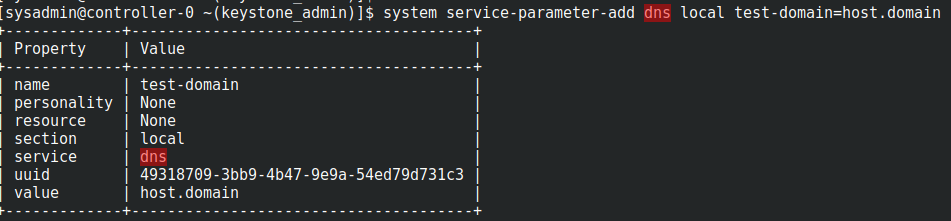
Example:
~(keystone_admin)]$ system service-parameter-add dns local test-domain=host.domain
Use the following command syntax to modify the parameter.
~(keystone_admin)]$ system service-parameter-modify dns local <local-scope-name>=<new_domain>
~(keystone_admin)]$ system service-parameter-apply dns
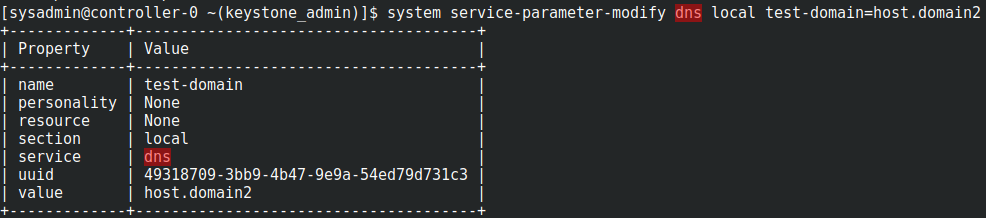
Example:
~(keystone_admin)]$ system service-parameter-modify dns local test-domain=host.domain2
Follow the steps below to delete the parameter.
Run the command to display the service parameter list for
dns local service-parametertype.~(keystone_admin)]$ system service-parameter-list | grep local
Copy the UUID of the parameter that needs to be deleted.
Run the command to delete the entry.
~(keystone_admin)]$ system service-parameter-delete <uuid>
For example:
~(keystone_admin)]$ system service-parameter-delete 49318709-3bb9-4b47-9e9a-54ed79d731c3
